Two panes · one spacer
Double-Pane Glass
7/8″ overall glass unit
The package shown has two panes and one sealed space. The spacer runs around the edge of that space.





An illustrated guide to the glass inside your windows—and the questions to ask before you choose.
Schedule your FREE in-home, no-obligation consultation today!
Glass choices, made visible
Two panes or three? Start by seeing the difference. Then compare the ratings of the complete window—not just a promising name for the glass.
A window pane is one sheet of glass. A sealed glass unit contains two or more panes separated by spacers and sealed spaces. The frame holds that unit; the sash is the part that may open. Keeping these terms separate makes a window quote easier to compare.
Start with the basics
One sheet of glass, without a sealed insulating space between panes. If your home has older single glazing, compare complete replacement-window ratings rather than the appearance of the glass alone.
Two sheets separated by one sealed space. The coating, gas fill, spacer and frame all affect the finished window; double-pane products are not all equivalent.
Three sheets and two sealed spaces. The additional pane can improve thermal performance in a suitable configuration, but compare its actual ratings, weight, room benefit and price.
The number of visible sections across a window is not its pane count. A picture window can have a double- or triple-pane sealed unit even though the view looks undivided.
01 / Inside the sealed unit
Two panes · one spacer
7/8″ overall glass unit
The package shown has two panes and one sealed space. The spacer runs around the edge of that space.
Three panes · two spacers
1 3/8″ overall glass unit
The package shown adds a middle pane and a second sealed space, with a spacer around each space.
Lower-edge diagrams, not to scale. Thicknesses describe the Falcon glass packages shown here, not every double- or triple-pane product and not the window-frame depth. We use Super Spacer® in our windows; confirm the exact model, coatings and gas fill in your quote.
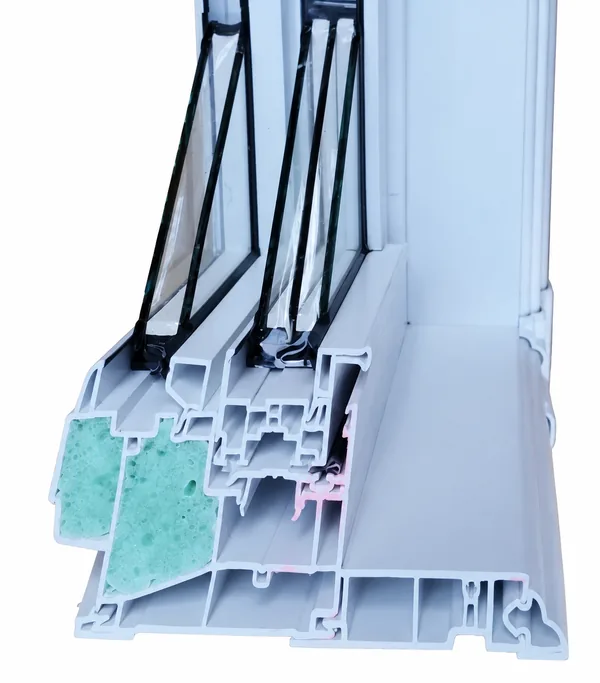
In the photograph, two panes are visible on the left and three on the right. The spacer is the component around the perimeter; it is not the empty space itself.
More panes do not tell you everything. The coating, spacer, frame and sealed-unit construction all belong in the comparison. Ask to handle a sample, then match it to the product specification.
Technical background: Cardinal Glass explains insulating glass units.
02 / Four useful questions
U-factor: a lower number means less heat transfer under the rating conditions. Request the whole-window value; a centre-of-glass figure leaves the frame out.
Solar Heat Gain Coefficient (SHGC): describes solar heat admitted through the window. Discuss orientation and shading; the lowest number is not automatically the best choice for every room.
Visible transmittance: helps compare daylight. Look at a glass sample as well as the number, especially if tint or the appearance of adjacent windows matters.
Check the exact configuration in the NRCan certified-product directory. A brand name or general ENERGY STAR statement is not the same as identifying the unit on your quote.
See Natural Resources Canada: ratings and certification for the Canadian Energy Rating (ER) and the meaning of the individual values.
Low-emissivity coatings reduce radiant heat transfer. Different packages manage solar heat differently, so the phrase “Low-E glass” alone is not a complete specification.
Argon can be used in a sealed glass unit. Confirm the fill for the chosen package; do not assume every multi-pane window has the same gas or that any fill is guaranteed to remain unchanged forever.
03 / Separate needs, separate specifications
Describe the source and the room. Ask about tested acoustic performance of the proposed assembly and whether different glass thicknesses or laminated glass are appropriate. “Triple pane” by itself is not a guarantee of a quiet room.
Ask which safety glazing is required for the opening and which product meets it. Heat-strengthened glass is not automatically safety glass. Do not use “stronger” as a substitute for the required specification.
Manufacturer reference: Pilkington on toughened and heat-strengthened glass.
No pane count guarantees silence, a fixed energy-bill saving or a payback date. UV filtering also depends on the glass package; sunlight damage is not caused by ultraviolet light alone.
04 / Compare like with like
See Falcon’s replacement-window and installation options when you are ready to discuss the complete project.
Useful answers
No. It is the overall sealed glass-unit thickness for the triple-pane package illustrated. The frame is a separate component with its own dimensions.
Yes. The red spacer blocks at the lower edges are labelled inside both diagrams. A double-pane unit has one perimeter spacer; the illustrated triple-pane unit has two.
Not necessarily. Moving air around the frame can be an installation or sealing issue. The opening needs to be assessed along with the glass specification.
Additional technical reading: NRCan window technology primer and Cardinal on laminated glass and fade protection. Product-specific benefits should be checked against the quoted manufacturer’s data.






15 White Vinyl Windows — Hamilton Project
READ MORE ⟶
Fiberglass Entry Door with Sidelights — Guelph Project
READ MORE ⟶
Bay and Bow Window Replacement in the GTA
READ MORE ⟶